Coalescer
COALESCER
Coalescing of oils is recommended to remove floating oils from the cleaner solution. Laboratory testing should be done to determine the extent that the oil will split from the cleaner and float. The coalescer may not be effective (and not recommended) with emulsifying cleaners and some cleaner / oil combinations where the oil does not float.
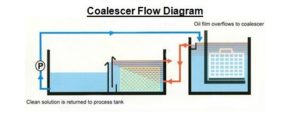
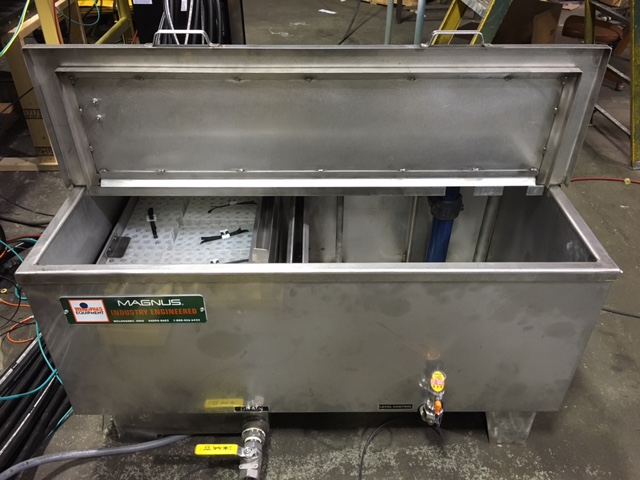
How does it work? Floating contaminates can be removed by incorporating a side stream coalescing system. The coalescing system is designed to use the natural gravity differences between oil and water to separate the oil and water as well as incorporating the oleophilic (oil attracting) properties of coalescing elements (such as polypropylene), to separate the oil. On a continuous basis, solution on the top of the process tank is ‘sparged’ to an overflow trough, which drains to the coalescing tank. This tank is designed to create a “quiet zone” which provides ample time for the floating contaminates (some oils, carbon, dust, etc.) to float to the top of the solution, where they can efficiently be removed with an overflow weir. The cleaned solution is then pumped back to the process tank. Its return flow is what creates the sparging effect across the top of the solution. It is imperative that the chosen cleaning chemical formula promotes the splitting/floating of oils and is not an emulsifying type of cleaner.